


Unlocking the US$42B Gas Framework: What Legal and Financial Close Means for Regional Industry
After months of negotiations on revenue-sharing mechanics and fiscal safeguards, Tanzania’s US$42 billion Liquefied Natural Gas (LNG) project is nearing completion of its final legal and commercial agreements.
Speaking in Dodoma, Finance Minister Khamis Mussa Omar confirmed that negotiations between the government and the international investor consortium, led by Equinor and Shell and including ExxonMobil, Pavilion Energy, Medco Energi, and state-owned TPDC, are entering their final stages.
With commercial, fiscal, and revenue-sharing terms largely resolved, the project is positioned to monetise more than 47.13 trillion cubic feet of deep-water natural gas reserves in the Lindi region. While most of the output is destined for global export markets, the project’s domestic allocations, energy infrastructure, and procurement pipelines will fundamentally reshape East Africa’s industrial and energy landscape.
PROJECT SNAPSHOT
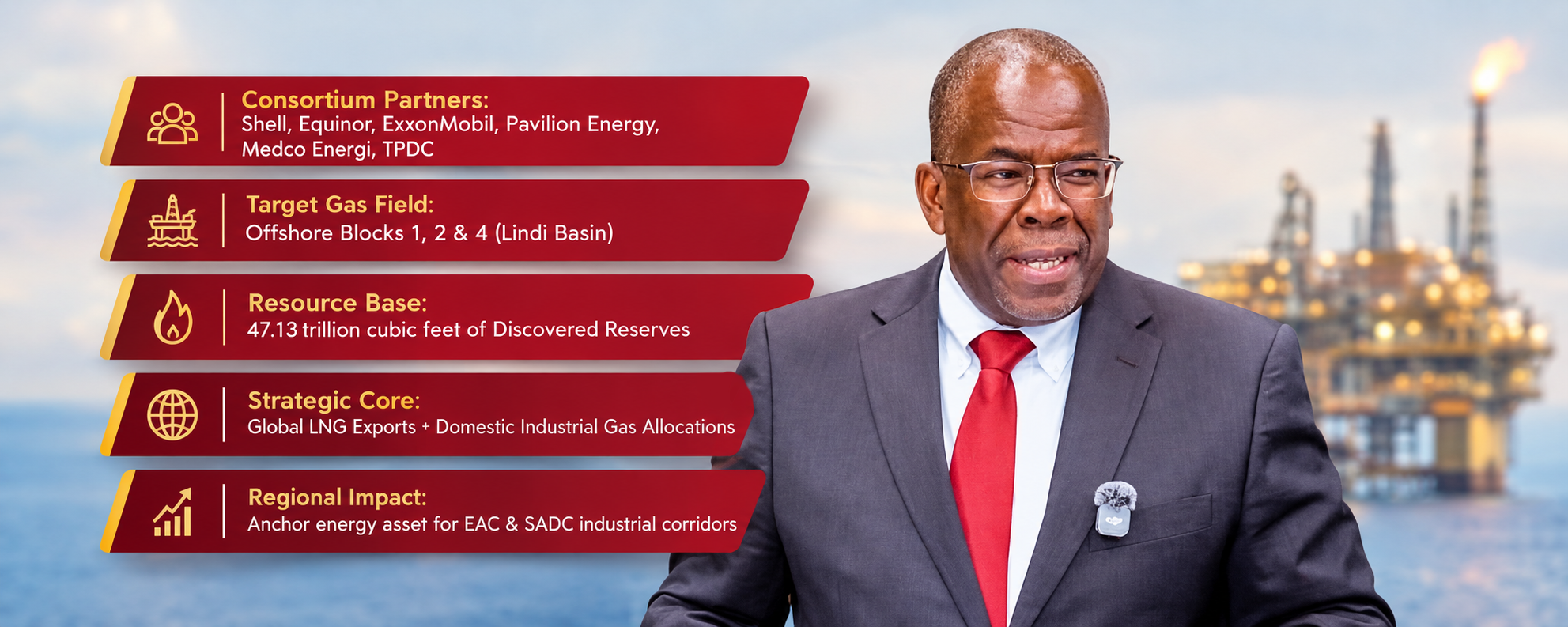
- • Consortium Partners: Shell, Equinor, ExxonMobil, Pavilion Energy, Medco Energi, TPDC
- • Target Gas Field: Offshore Blocks 1, 2 & 4 (Lindi Basin)
- • Resource Base: 47.13 trillion cubic feet of Discovered Reserves
- • Strategic Core: Global LNG Exports + Domestic Industrial Gas Allocations
- • Regional Impact: Anchor energy asset for EAC & SADC industrial corridors
STRATEGIC C-SUITE TAKEAWAYS
- The Domestic Allocation Strategy: Lowering Base-Load Power Costs
For manufacturing executives, power costs across East Africa remain a core operational bottleneck. A central pillar of Tanzania’s negotiation strategy has been to secure a dedicated share of deep-sea natural gas for domestic power generation and direct industrial processing.
- Industrial Cost Offsetting: Direct gas off-take pipeline allocations for heavy manufacturing hubs (Dar es Salaam, Bagamoyo, and Dodoma) will offer a cheaper alternative to power generation using heavy fuel oil (HFO) and diesel.
- Grid Stability: Integrating large-scale gas-to-power into the national grid alongside the Julius Nyerere Hydropower Project (JNHPP) provides reliable base-load capacity. This dramatically reduces the risk of power rationing for heavy processing plants across the country.
- Timeline to Final Investment Decision (FID) & Capital Mobilisation
While the legal framework agreement marks a major milestone, C-suites must manage timelines conservatively.
- Engineering & Procurement Onboarding: Following the formal host government agreement (HGA) execution, the consortium will enter the definitive Front-End Engineering Design (FEED) phase, leading towards the Final Investment Decision (FID).
- CapEx Rollout Horizon: Massive physical infrastructure works, including offshore subsea production units, onshore liquefaction trains, and pipeline networks, will roll out over a 4-to-6-year construction window, creating a sustained multi-billion-dollar civil and marine construction pipeline.
- Early Supply-Chain & Local Content Requirements
The scale of a US$42 billion capital project will strain local logistics, supply chains, and technical capacity. Regional contractors and service providers must begin positioning themselves early to meet strict local content regulations under the Tanzania Petroleum Upstream Act.
- Tier-1 & Tier-2 Contractor Opportunities: Immediate demand will centre on specialised civil engineering, heavy freight transport, marine logistics, environmental compliance monitoring, catering/camp facilities, and high-spec security services.
- Joint Ventures & Standards Compliance: International engineering, procurement, and construction (EPC) contractors will actively seek local joint-venture partners to fulfil local equity and labour requirements. Regional firms that pre-qualify their ISO certifications and health, safety, and environment (HSE) standards early will capture the largest subcontracts.
MACRO & REGIONAL TRADE CONTEXT
The LNG project does not exist in isolation; it anchors a broader macroeconomic shift across the East African Community (EAC). Paired with the East African Crude Oil Pipeline (EACOP) from Uganda to Tanga, Tanzania is securing its position as the primary maritime and energy export corridor for East and Central Africa.
- Uganda to Tanga Corridor: Hoima Oilfields are connected via the EACOP Crude Pipeline directly to Tanga Port for global export.
- Lindi Energy Hub: Lindi Offshore Blocks connected directly to the US$42B LNG hub for domestic grid support, regional pipelines, and international exports.
- Industrial Nodes: Direct gas links to the industrial districts of Dodoma and Dar es Salaam.
For corporate leadership across Kenya, Tanzania, and Uganda, the legal closure of the US$42B LNG deal marks the start of a decade-long capital expenditure cycle. Companies that align their supply-chain footprint, energy sourcing, and regional logistics strategies with this pipeline stand to gain a structural advantage in East Africa’s emerging industrial landscape.