Tanzania’s Reforms Drive Rise in the Global Minerals Race
Five years ago, Tanzania’s mining sector was a footnote in its economic story, a resource rich in promise but light on delivery. That narrative has been rewritten. Today, mining sits at the heart of the country’s growth engine, and the numbers tell a story too interesting to ignore. Government revenue from the sector has nearly tripled since 2020, foreign investors are lining up, and a nation once content exporting raw ore is now talking about building factories instead.
Margins to Mainstream
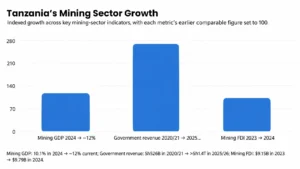
For years, Tanzania’s vast mineral deposits sat underexploited relative to their potential. The sector’s contribution to GDP hovered below 10 percent, and much of the value created by Tanzanian minerals was captured elsewhere like refineries and factories outside the country’s borders. That has shifted sharply. GDP contribution from mining climbed to a record 10.1 percent in 2024 and has since settled between 11.9 and 12 percent, while government revenue jumped from Sh526 billion in 2020/21 to more than Sh1.4 trillion in 2025/26, beating targets by 16 percent. Foreign direct investment in mining followed the same trajectory, rising to $9.79 billion in 2024 from $9.15 billion the year before, part of a broader national FDI climb to roughly $5 billion in 2025.
This turnaround didn’t happen by accident. It followed a deliberate recalibration of mining policy, through revisions to the 2018 Mining Regulations designed to ensure that Tanzanians, not just multinational investors, benefit from what comes out of the ground. The results are tangible: Tanzanian employment in mining rose from 6,668 workers in 2018 to more than 18,800 by 2024, now accounting for over 97 percent of all mining jobs in the country. Local procurement climbed too, from 62 percent to 88 percent over the same period. It’s a shift that logistics consultants have watched unfold, noting that Tanzanian firms are now managing complex supply chains and securing multi-million-dollar subcontracts that would once have gone to foreign companies.
Beyond the Gold
Gold remains the sector’s workhorse, pulling in $4.75 billion in export earnings in 2025 alone. But the more interesting story may be what’s happening beneath the surface, literally. Tanzania sits on globally significant deposits of nickel, graphite, cobalt, lithium and rare earth elements, the raw materials of the electric vehicle and renewable energy boom sweeping the planet. The Kabanga Nickel Project, with more than 209 million tonnes of proven deposits, and the Bunyu Graphite Project, drawing fresh equity financing from Australian explorers, Tanzania is positioning itself as one of its essential suppliers.
Small-Scale Miners Nobody Can Ignore
Part of what held Tanzania back for years was a large, informal artisanal mining sector operating outside the reach of policy and finance. That, too, has changed. With over 6 million Tanzanians tied to artisanal and small-scale mining, the government has moved to formalise and equip the sector. The government has issued 511 licenses, procured modern rock-drilling machines, and channelled Sh187 billion in financing. Small-scale miners now account for nearly 40 percent of national gold output, up from around 5 percent before the 2017 Mining Act amendments. This is proof that inclusion, not exclusion, has been part of the growth formula.
The macro picture explains why officials are so eager to talk about mining. Minerals made up 50 to 55 percent of Tanzania’s total exports in 2025, generating between $4.4 and $4.7 billion. This helped push foreign exchange reserves to about $6.6 billion, enough to cover more than five months of imports. That’s not a side industry; that’s a pillar holding up the national economy.
What ties all of this together is a change in ambition. As President Samia Suluhu Hassan stated at St Petersburg Russia, Tanzania no longer wants to simply dig and sell, it wants to build, process and profit locally.
Whether that ambition fully materialises will depend on sustained investment in processing infrastructure and skills. But for a country once seen as a minor player in the minerals race, Tanzania is now unmistakably in the running, and it’s inviting the world to watch closely.