


Tanzania and Japan Affirm Strong Bilateral Development Ties Across Infrastructure, Trade, and Cultural Exchange

When Tanganyika achieved independence in December 1961, Japan was among the earliest sovereign nations to extend formal diplomatic recognition. Over six decades later, the partnership between the United Republic of Tanzania and Japan stands out as a model of international development and economic alignment in East Africa. What originated as traditional, post-independence development assistance has steadily matured into a strategic partnership focused on sustainable infrastructure development, dynamic two-way trade, and deep cultural exchange.
Transforming Urban and National Infrastructure
Infrastructure development has long been a flagship pillar of Japanese engagement in Tanzania. Delivered primarily through the Japan International Cooperation Agency (JICA), Japanese concessional loans, technical expertise, and grant assistance have systematically targeted chronic bottlenecks in urban mobility, regional transit, and utility networks.
The most visible testament to this engineering collaboration is the landmark Mfugale Flyover at the bustling Tazara intersection in Dar es Salaam. As Tanzania’s first proper flyover, the Japanese-built structure dramatically reduced transit times across East Africa’s largest commercial metropolis. Complementing this achievement are major upgrades to Dar es Salaam’s broader road transport network, rural water distribution systems, and high-voltage electrical grid expansions across central regions, including the Dodoma Inner Ring Road development.
In recent high-level diplomatic forums, both governments signalled a shift toward direct economic co-creation. Tanzania is positioning itself as the premier logistics gateway for land-locked Central African neighbours, actively inviting Japanese private enterprises to participate in flagship national mega-projects, including:
- Standard Gauge Railway (SGR): Creating opportunities for Japanese investment in advanced rolling stock, automated signalling systems, and long-term rail asset management.
- Maritime & Port Logistics: Enhancing modern container operations and cold-chain capacity at the key ports of Dar es Salaam, Tanga, and Mtwara.
- Smart Urban Transit: Conducting feasibility assessments for critical congestion hubs, such as the proposed Morocco Flyover, alongside integrated traffic-control software.
Expanding Commercial Trade and Agricultural Modernisation
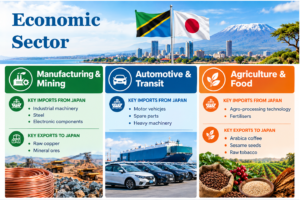
Trade relations between Tanzania and Japan showcase complementary economic strengths. Japan remains a trusted supplier of industrial machinery, heavy construction equipment, commercial vehicles, and high-grade steel products to East Africa. Japanese automotive brands, most notably Toyota, Nissan, and Mitsubishi, dominate Tanzanian roadways, supported by local assembly, distribution networks, and skilled technical maintenance jobs.
In return, Tanzania serves as an essential agricultural exporter to Japan’s domestic market. Japan is one of the primary Asian buyers of high-grade Tanzanian Arabica coffee beans, which Japanese speciality roasters highly value. Additionally, Tanzanian sesame seed exports hold a dominant market share in Japan’s food processing industry, supplemented by steady shipments of raw tobacco and copper.
To safeguard food security and elevate rural household incomes, JICA has spent over forty years facilitating technology transfers within Tanzania’s agricultural sector. The Lower Moshi Irrigation Scheme in Kilimanjaro is a prime example: Japanese engineering introduced modern canal systems, field-levelling techniques, and high-yield rice cultivation methods that quadrupled local harvest production.
Deepening People-to-People Connections and Technical Exchange
Beyond capital-intensive projects and trade agreements lies a human connection rooted in voluntary service and institutional education.
Tanzania became the second African country to welcome the Japan Overseas Cooperation Volunteers (JOCV) program in 1967. Over the past half-century, more than 1,700 Japanese volunteers, including science teachers, vocational instructors, civil engineers, health professionals, and agricultural advisors, have lived and worked alongside local communities across mainland Tanzania and Zanzibar.
This exchange flows equally in return:
- Academic Fellowships: Hundreds of Tanzanian civil servants, engineers, and researchers have earned master’s and doctoral degrees at elite Japanese universities through government-funded initiatives like the ABE Initiative (African Business Education Initiative for Youth).
- Grassroots Sister-City Links: Regional partnerships, such as Nagai City serving as the official host town for Tanzanian Olympic and Paralympic athletes, have cultivated lasting ties in sports diplomacy, tourism, and student exchanges.
Looking Ahead: Strategic Alignment for Shared Growth
As both nations look forward under international diplomatic frameworks like the Tokyo International Conference on African Development (TICAD), the Tanzania–Japan partnership is adapting to modern global priorities. Future cooperation emphasises joint-venture business models, renewable energy expansion, digital governance, and climate-resilient infrastructure. By pairing Japan’s capital precision and technical expertise with Tanzania’s rich resource base, strategic geographic position, and favourable investment climate, both countries continue to solidify a resilient alliance built to deliver shared prosperity for decades to come.