


Betting on Mega Investments to Drive Tanzania’s Next Growth Phase
Big projects are easy to measure in billions of dollars. Their real value, however, is felt much closer to home in the jobs they create, the businesses they support and the income that reaches ordinary households. Tanzania is betting heavily on that connection.
The government expects the economy to grow by 6.3 per cent in 2026, driven in part by a pipeline of major investments in mining, natural gas, energy and infrastructure. Finance Minister Khamis Mussa Omar says projects ranging from new gold and critical-mineral mines to the long-awaited liquefied natural gas (LNG) development could propel an already resilient economy into its next phase.
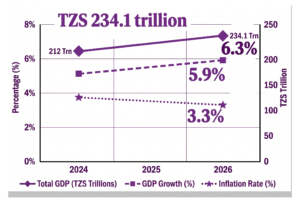
Recent data offer some grounds for confidence. Tanzania’s economy grew by 5.9 per cent in 2025, while GDP rose to TZS 234.1 trillion from TZS 212 trillion in 2024. Inflation averaged a relatively modest 3.3 per cent, helping preserve macroeconomic stability despite continued global uncertainty.
Mining Takes Centre Stage in Growth Push
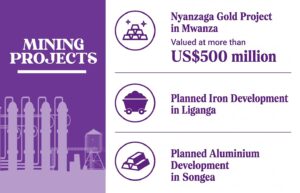 Mining sits at the centre of the government’s strategy. Among the projects moving towards implementation are the Nyanzaga Gold Project in Mwanza, valued at more than US$500 million, and planned iron and aluminium developments in Liganga and Songea.
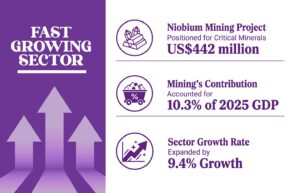 The government is also banking on a recently signed US$442 million niobium project, strengthening Tanzania’s efforts to position itself in the growing global market for critical minerals. Mining accounted for 10.3 per cent of GDP in 2025 and expanded by 9.4 per cent, making it one of the country’s fastest-growing sectors.
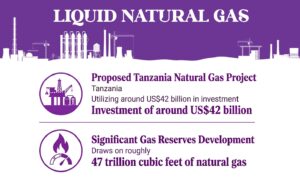 Then there is the much larger prize: LNG. Tanzania’s proposed development could involve an investment of around US$42 billion, drawing on roughly 47 trillion cubic feet of natural gas. If long-running negotiations culminate in a final investment decision, the project would dwarf most investments currently underway in the country.
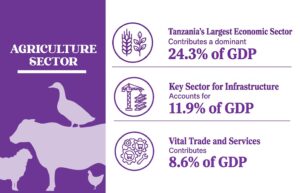 Agriculture remains Tanzania’s largest economic sector, contributing 24.3 per cent of GDP, followed by construction at 11.9 per cent. Trade and repair services contributed 8.6 per cent, while transport and storage accounted for 8.3 per cent.
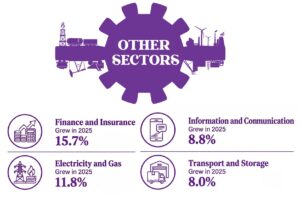 Several other sectors are also expanding rapidly. Finance and insurance grew by 15.7 per cent in 2025, electricity and gas by 11.8 per cent, information and communication by 8.8 per cent, and transport and storage by 8 per cent.
That breadth matters. An economy dependent on a handful of mines or a single gas project would remain vulnerable to commodity-price swings and investment delays. A wider base of activity provides a stronger cushion.
Foreign investors are also showing greater interest. Foreign direct investment inflows rose 28.3 per cent to US$1.72 billion in 2024, up from US$1.34 billion a year earlier, with mining attracting the largest share.
The 6.3% Question
The government’s target is ambitious, but not guaranteed. The International Monetary Fund (IMF) also sees Tanzania’s underlying outlook as strong, projecting growth of around 6.3 per cent over the medium term, supported by mining, agriculture and tourism.
But mega-projects do not move from announcement to economic impact overnight. Construction schedules can slip, commodity prices fluctuate, and investment decisions can take years. Tanzania’s LNG negotiations illustrate how long a project can remain promising without reaching implementation.
External pressures pose another risk. Higher fuel and fertiliser prices, geopolitical instability and reduced development assistance could affect transport, agriculture and tourism while putting pressure on inflation and government finances.
From Investment to Everyday Growth
The government is targeting the creation of 1.7 million jobs, making employment one of the clearest measures of whether its investment strategy is working. That is where Tanzania’s growth story will ultimately be tested.
A US$500 million mine matters more when local companies supply it. An LNG project becomes transformative when Tanzanians acquire the skills and businesses needed to participate in its supply chain. New electricity generation matters when factories can operate more reliably and expand production.
Tanzania has assembled an unusually large investment pipeline, and the economy enters this period with strong momentum. But 6.3 per cent will ultimately be just a number if the benefits of that growth remain concentrated.
The bigger opportunity is to ensure that billions flowing into mines, energy and infrastructure also flow outward into businesses, employment and household incomes. That is when mega-investment becomes economic transformation.