


Taxing the Shadow Economy: The Policy Arithmetic of Tanzania’s FYDP IV and the 1% Sector Withholding Mandate

As Tanzania implements its long-term economic roadmap under Dira 2050, the country faces a significant structural challenge. Central to achieving greater economic self-reliance is the Fourth Five-Year Development Plan (FYDP IV: 2026/27–2030/31), which targets increasing the national tax-to-GDP ratio from 16.5% to 17.1%. To broaden the tax base, fiscal authorities have introduced withholding measures, most notably a 1% withholding tax on primary agricultural produce, livestock and marine products at the point of sale.
Although intended to capture revenue from an informal sector that employs more than 65% of the workforce, the policy presents significant economic trade-offs. This analysis examines the tension between immediate revenue collection at the farm gate and sustainable formalisation, assessing administrative bottlenecks, market distortions and alternative policy approaches to supporting national growth.
- The Fiscal Imperative Under FYDP IV
Despite improvements arising from Tanzania Revenue Authority (TRA) digital upgrades, domestic revenue mobilisation remains constrained by a narrow formal tax base. Corporate enterprises, formal-sector employees and commercial importers bear a substantial share of direct taxes and value-added tax (VAT). Under FYDP IV, financing major commitments, including the Julius Nyerere Hydropower Project, regional railway expansions and rural electricity networks, requires the mobilisation of additional domestic resources.
Given the importance of primary production to rural economic activity, policymakers view trade in agricultural and other primary products as a significant untapped source of tax revenue. The 1% withholding mandate operates as an advance tax mechanism: off-takers, commercial buyers, processors and primary cooperatives must deduct 1% from gross payments to smallholders and traders at landing sites, remitting the funds directly to the TRA.
- The Formalisation Paradox
Enforcing withholding mechanisms across fragmented primary-production markets creates a distinct formalisation paradox:
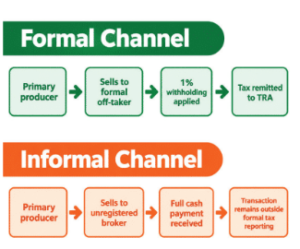
Capital Shifts to Informal Channels
In agricultural trade and small-scale fisheries, immediate liquidity often determines market behaviour. When formal buyers enforce a 1% deduction at the farm gate or landing site, some primary producers may bypass official channels and choose informal brokers who pay the full cash price without deductions. Rather than bringing informal operators into the tax system, the levy risks shifting more transactions into unrecorded cash networks.
High Compliance and Administrative Costs
Designating processors, aggregators and rural cooperatives as withholding agents creates substantial operational and administrative burdens.
- Logistical Complexity: Rural buyers operating across dispersed collection points face demanding bookkeeping requirements and Electronic Fiscal Device (EFD) obligations for thousands of small transactions.
- Working Capital Constraints: In low-margin commodity trading, including maize, rice and fresh fish, a 1% levy on gross transactions can reduce available liquidity and increase working capital pressures throughout the supply chain.
- Supply Chain Effects and Food Inflation
Collecting revenue at the primary-production stage can trigger cost adjustments across national and regional value chains.
- Primary Producers (Farmers and Fishermen): Face lower cash receipts at the point of sale, potentially reducing their capacity to invest in quality inputs and improve productivity.
- Aggregators and Off-Takers: Face additional compliance costs, audit exposure and potential tax liabilities, which may create incentives to under-report transactions or shift towards informal trading channels.
- Urban Wholesalers and Retailers: May pass additional costs down the supply chain, placing upward pressure on food prices in major consumer markets.
- Regional Exporters: May face higher costs than competitors in other East African Community (EAC) and Southern African Development Community (SADC) markets, potentially weakening their price competitiveness in cross-border trade.
Household budgets in major urban centres, including Dar es Salaam, Dodoma and Mwanza, are particularly sensitive to food prices. Consequently, withholding at the farm gate could contribute to broader cost-of-living pressures if producers pass the costs on to consumers.
- Resolving the Double-Taxation Trap
A key source of market friction is the overlap between central government taxation and levies imposed by local government authorities (LGAs). Local councils rely partly on produce cess collected at municipal transit barriers. The TRA’s 1% national withholding tax introduces an additional layer of taxation on transactions that may already be subject to local levies.
This overlapping system can discourage compliance, delay municipal checkpoints, and encourage traders to bypass official routes. Such responses risk undermining both local government revenue collection and central government tax receipts.
- Strategic Policy Recommendations
Rather than relying primarily on point-of-sale withholding, Tanzania could pursue more sustainable tax-base expansion under FYDP IV through digital integration, targeted incentives and harmonised administration.
- Integrate Digital Financial Networks: Link TRA systems with mobile money operators and the National Identification Authority (NIDA) database. Incentivising transactions through registered mobile wallets, including through proportionate tax credits or rebates, could improve transaction traceability while reducing the administrative burden on primary producers.
- Introduce Value-Addition Credits: Redesign the 1% withholding mechanism to allow eligible smallholders and cooperatives to offset qualifying tax credits against expenditure on certified seeds, fertilisers and cold-storage facilities. This approach could reduce the effective cost of compliance while encouraging investment in productivity and potentially supporting access to formal credit.
- Harmonise LGA Cess with Central Tax Portals: Consolidate municipal produce cess and TRA withholding into a unified digital clearance system, with automated allocation of revenue between the relevant authorities. This could eliminate duplicative checkpoints, reduce delays and streamline the movement of agricultural commodities across regions.

Broadening the tax base to include primary economic sectors remains important to achieving the objectives of Dira 2050 and FYDP IV. However, effective policy design must balance short-term revenue collection against long-term economic formalisation and market integration.
By shifting toward digital integration, proportionate compliance requirements, and harmonised tax administration, Tanzania could improve transaction traceability, reduce opportunities for tax evasion, and make the informal economy a more reliable contributor to sustainable national growth.