


New Competition Rules Put Market Power Under the Microscope
For a business that has spent years building a dominant position in its market, success can create an unexpected problem: the bigger it becomes, the more closely its commercial decisions may be examined. This is the policy question now facing businesses operating in Tanzania following the publication of the Fair Competition (Abuse of Dominant Position) Regulations, 2026.
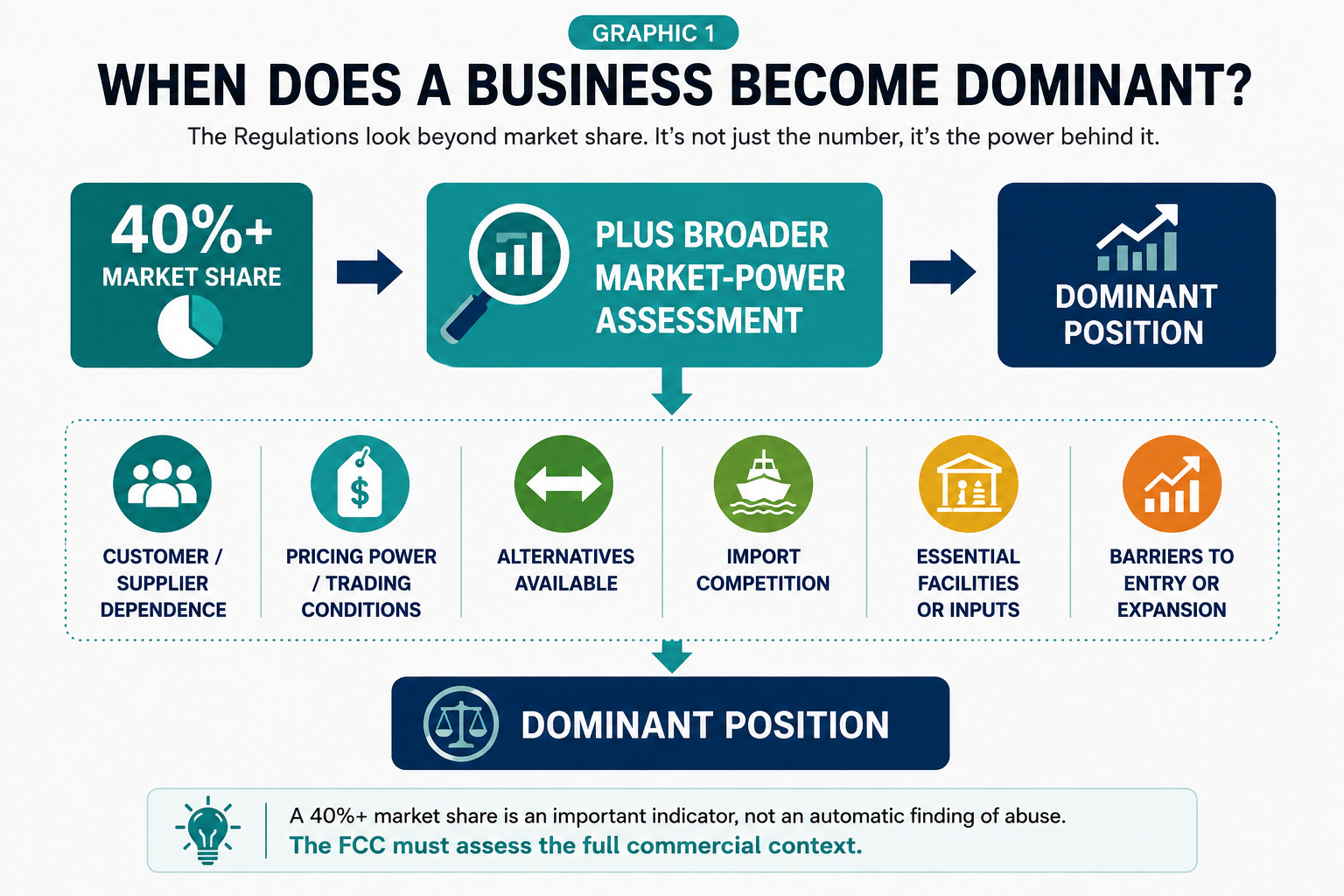
Published under Government Notice No. 244 on 14 August, the new Regulations give the Fair Competition Commission (FCC) a more detailed framework for determining when a business is dominant and, more importantly, when that dominance may have been abused. They operationalise changes introduced by the Fair Competition (Amendment) Act, 2024, including raising the market-share benchmark for dominance from 35% to 40% and recognising the concept of joint dominance.
The significance for business, however, is not simply that the number has moved from 35% to 40%. The bigger change is that market power is being assessed through a wider commercial lens.
The Regulations make clear that market share is an important indicator, rather than a standalone answer. The FCC can consider whether customers, consumers or suppliers depend on a particular business, whether it can determine prices or trading conditions independently, the strength of alternative products, import competition, control over essential facilities or inputs, and barriers facing new or expanding competitors.
Being successful is not, in itself, a competition offence. A company can have a large market share without breaking the law. The concern arises when market power is used to exploit customers or to prevent, restrict or distort competition, putting focus firmly on conduct.
From market leadership to market behaviour
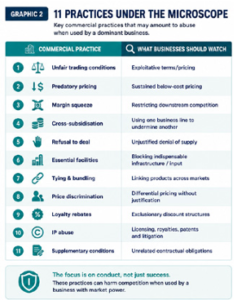
The new framework identifies a broad range of practices that could amount to abuse. These include unfair prices or trading conditions, predatory pricing, margin squeeze, cross-subsidisation, refusal to deal, denial of access to essential facilities, tying and bundling, price discrimination, loyalty discounts and rebates, abuse of intellectual property rights, and imposing unrelated supplementary contractual conditions.
For businesses, these are not abstract legal concepts. They sit inside ordinary commercial decisions. A pricing team deciding how aggressively to price a new product, for example, may not think of itself as making a competition-law decision. A sales team designing a loyalty rebate may be focused on retaining customers. A technology company negotiating a licence may simply be protecting its intellectual property.
The Regulations introduce another question into each of these decisions: could the practice, when used by a dominant business, weaken competition? Consequently, compliance becomes a management issue rather than something left to the legal department.
Pricing decisions will require more context
Selling at a low price is not automatically anti-competitive. The Regulations look at circumstances including sustained below-cost pricing, the ability of the business to absorb losses and the possibility of recovering those losses through subsequent price increases, while also allowing room for reasonable economic justification.
This matters in competitive markets where businesses routinely discount products, launch new services or accept short-term losses to acquire customers. The question will increasingly be whether a dominant business can explain the commercial logic behind its conduct.
The same principle applies to rebates and discounts. A loyalty programme can be an entirely legitimate way of rewarding customers. It becomes more complicated where a dominant business structures discounts in a way that effectively makes it difficult for competitors to attract or retain customers.
The implication is subtle but important: commercial rationale will matter, but so will commercial effect.
Essential Facilities Could Become a Bigger Issue
Another area worth watching is access to essential facilities or inputs. In some markets, competitors cannot realistically operate without access to particular infrastructure, networks, platforms, facilities or critical inputs. A business controlling such an asset may therefore possess influence extending beyond its own products or services.
The new Regulations give the FCC a framework for examining whether denial of access or discriminatory access conditions amount to abuse. For infrastructure-heavy industries, this could make access arrangements an increasingly important competition-policy issue.
It also raises a wider question for policymakers: how should Tanzania encourage companies to invest in infrastructure while ensuring that control of strategically important assets does not become a barrier to competition?
Intellectual Property is Now Part of the Conversation
The Regulations also bring intellectual property more explicitly into the abuse-of-dominance debate.
A company should be able to protect its patents, technology and other intellectual property. The challenge arises where those rights are used not simply to protect innovation but to exclude competitors.
The Regulations identify potential concerns including unjustified refusal to license, excessive royalty rates, discriminatory licensing conditions, unnecessary additional licensing requirements and strategic patent practices designed to delay or prevent market entry.
For technology, pharmaceutical and manufacturing businesses, this creates an important balancing act between protecting innovation and ensuring that intellectual property does not become a tool for shutting down competition. 
Response from Businesses
The immediate response should not be to assume that every dominant business is under threat. Instead, businesses with substantial market power should understand how their relevant market would be defined and assess the commercial practices most likely to attract scrutiny.
That means reviewing pricing models, rebate and discount structures, distribution agreements, exclusivity arrangements, access policies, licensing terms and contractual conditions. It also means bringing competition considerations closer to commercial decision-making.
For boards and senior management, the issue is increasingly one of governance. For commercial teams, it is about understanding that a decision that makes perfect business sense in isolation may carry a different risk when made by a company with substantial market power.
Tanzania’s new framework is therefore less about punishing businesses for becoming successful and more about drawing a line around how that success is exercised.
That is an important distinction for businesses to understand. Market leadership remains legitimate. Aggressive competition remains legitimate. Innovation, investment and commercial strategy remain legitimate.
The regulatory question is what happens when market power becomes strong enough to shape the choices available to everyone else. The new Regulations give Tanzania’s competition authorities a clearer framework for asking that question. Businesses will now need to be equally clear about how they answer it.