


From Blue Economy to Micro-Fintech: How Tanzania is Positioning Itself as East Africa’s Next Tech Hub

For years, the narrative about East African innovation focused almost exclusively on Nairobi’s “Silicon Savannah” and Kigali’s tech incubators. Yet in Tanzania, a distinct structural story is taking shape. Driven by steady real GDP growth of about 6%, expanding 5G infrastructure, and a rapidly maturing founder ecosystem, Tanzania is becoming a major regional commercial hub.
Rather than copying the Silicon Valley templates, Tanzanian entrepreneurs are building hyper-localised, data-driven platforms engineered directly for the country’s economic realities, from coastal marine logistics to agricultural micro-supply chains.
Solving Real-World Bottlenecks with Localised Tech
The fundamental driver of Tanzania’s tech acceleration is a shift away from generic consumer applications towards deep operational tools. Tens of millions of active mobile money wallets operate across the nation, creating a digital payment culture that underpins the transactional rails for high-impact innovation. These include:
Fintech & Supply Chain Logistics: Companies such as NALA (cross-border remittances) and Ramani (supply-chain financing for micro-distributors) demonstrate that localised financial engineering unlocks rapid enterprise value. By offering credit solutions directly linked to point-of-sale inventory management, these platforms address liquidity constraints for small and medium-sized enterprises (SMEs) that traditional commercial banks have historically overlooked.
AgriTech & Climate Intelligence: Agriculture remains the backbone of the national economy, employing the majority of the workforce. Platforms such as AgriNEXA use localised climate modelling and Swahili-first messaging tools to deliver real-time yield advisories to rural farmers. By directly linking micro-farmers to regional buyers, these systems remove middleman inefficiencies and buffer rural communities against shifting climate cycles.
AI-Enabled Telehealth: In health-tech, startups such as Medikea integrate lightweight diagnostic triage tools directly into mobile messaging channels, lowering barriers to physical access for urban and peri-urban patients seeking rapid consultation.
Corporate Momentum Meets Institutional Policy
Private-sector innovation is increasingly supported by enterprise infrastructure modernisations and aligned policy frameworks. Telecom leaders such as Yas Tanzania (formerly Tigo) continue to expand dedicated business units (Yas Business) to equip growing mid-market enterprises with enterprise cloud services, high-speed 5G, and unified communications. At the same time, financial arms such as Mixx by Yas (formerly Tigo Pesa) are broadening API integrations for local corporate payment flows.
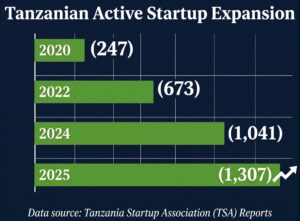
At the macro policy level, advocacy bodies such as the Tanzania Startup Association (TSA) work alongside government agencies, including the National Planning Commission and the Commission for Science and Technology (COSTECH), to streamline regulations. Recent TSA data indicate that more than 1,300 tech startups are active in Tanzania, marking a significant expansion that outpaces regional peers.
Tanzanian Active Startup Expansion
Concurrently, national investment in the Blue Economy, encompassing marine logistics, sustainable fisheries, coastal aquaculture, and port modernisation along Tanzania’s 1,400+ kilometre coastline, is opening a new frontier for maritime tech. Digitised port scheduling, automated cold-chain tracking for ocean exports, and direct-to-buyer digital marketplaces for coastal fishing communities are quickly emerging as leading investment channels.
Overcoming Roadblocks on the Scale-Up Path
Despite rapid growth, structural hurdles remain. Early-stage founders face a notable capital bottleneck when scaling from seed to Series A. While international venture capital has historically dominated African deal flow, domestic capital networks and regional banks are increasingly stepping in to fund local founding teams. Expanding high-speed fibre connectivity and digital literacy into deep rural areas also remains vital for long-term equity.
These challenges are prompting greater maturity across the ecosystem. Annual ecosystem gatherings such as Tanzania Startup Week continue to attract international venture firms, angels, and policymakers to Dar es Salaam to secure early deal access.
The Bottom Line
Tanzania’s tech evolution is defined by practical utility rather than market hype. By anchoring digital tools directly to core sectors, including fintech, agriculture, logistics, and the marine economy, the nation is executing an innovation model that is resilient, scalable, and uniquely built for East Africa’s economic future. For investors, corporate partners, and technology analysts, Tanzania is no longer an emerging market to monitor passively; it is an active powerhouse demanding direct engagement.